The importance of healthy risk taking and how it builds resilient kids
In this three-part series on children's mental health, learn about perfectionism, healthy risk taking and everyday habits to build kids' emotional resilience, to help you parent with confidence and support your child's well-being.
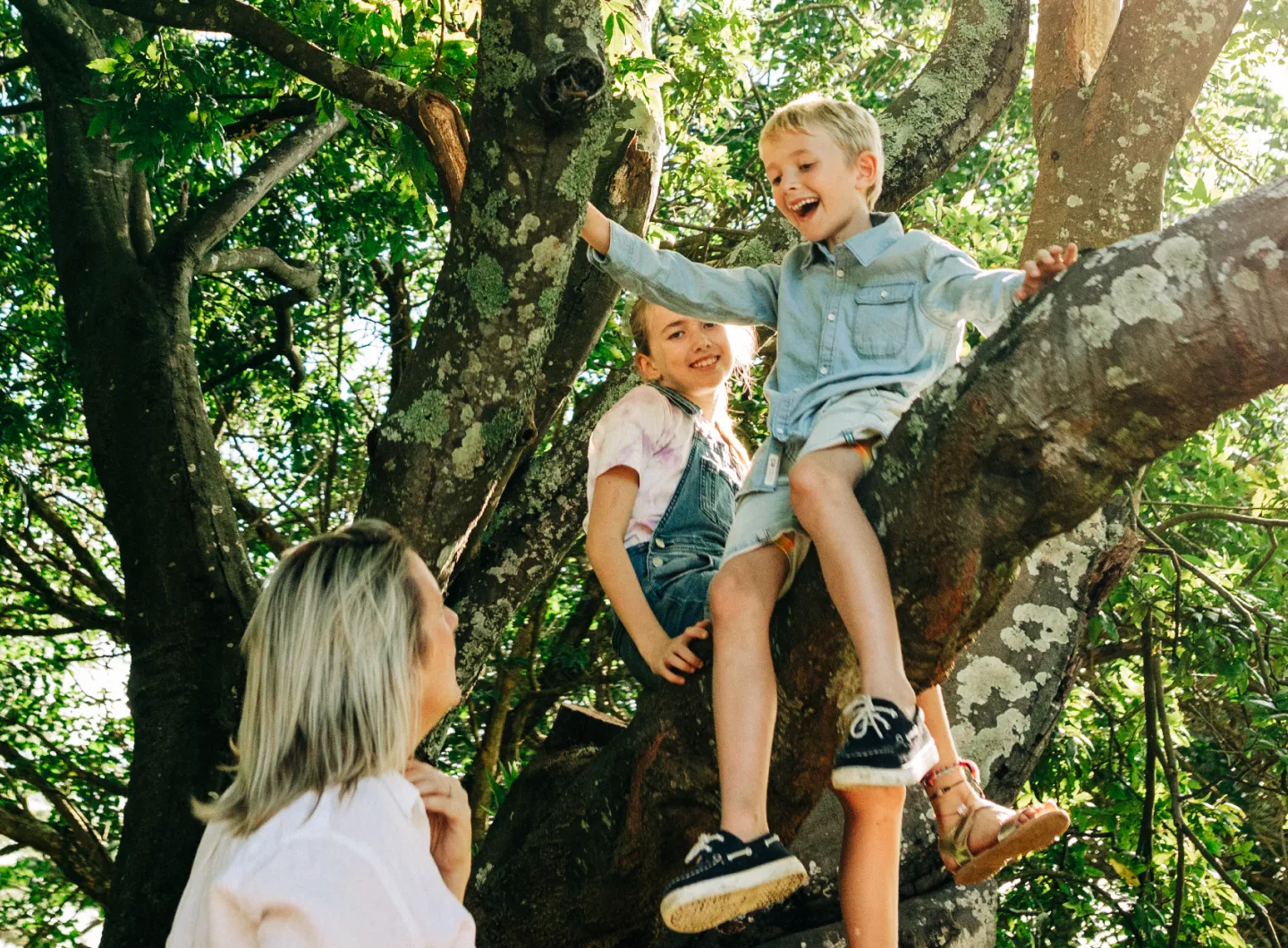
If watching your child climb a tree, jump from high playground equipment or ride a bike to the park with friends makes you nervous, you're not alone.
The world can feel like a scary and dangerous place sometimes, and every parent and caregiver wants to keep their child safe. At the same time, for children to learn and grow they need to take some risks and try new things.
Finding the right balance between encouraging safety and adventure in our children can be difficult. But when we get it right, the benefits are huge. Research shows when children are given opportunities to play adventurously and take appropriate risks, it can do wonders for their mental health, confidence and independence1.
So what does healthy risk taking look like? And how can we best support our kids to discover their capabilities without worrying ourselves sick?
The benefits of appropriate risk taking for children and teens
First, let's be clear. Children engaging in reckless or extremely dangerous behaviors is never a good idea. If it's life-threatening, high risk or illegal, make sure you keep them from doing it and have a good conversation about it.*
By nature, there will always be some level of risk involved in adventurous play. But it can help to remember that stopping children from taking risks can be harmful too.
Research on the benefits of children taking risks suggests those who spend more time playing adventurously are less likely to experience anxiety and broader mental health problems1. It can also help them feel good, test their limits, regulate their emotions, and gain problem-solving and coping skills.
Adventurous play is defined as child-led play where children experience feelings of excitement, thrill and fear, usually while taking healthy risks2. It may come as no surprise that children play most adventurously outdoors and in green spaces such as parks, forests, and open grassy areas. This is followed by indoor play center, trampoline parks and playgrounds1.
By allowing children to discover their capabilities, parents and caregivers can help them build their confidence and grow their independence – not to mention get them off their devices more easily. It's also comforting to know that for children growing up in western societies, the risk of being injured during play is very low3.
Types of healthy risk taking for children and teenagers
It can be difficult working out exactly what age-appropriate risks look like. Children of the same age will be capable of different things at different times. Often, it can help to follow their lead.
Maybe your young child is climbing a tree higher than you'd like. Or your 10-year-old wants to ride their bike around the block. Or your young teenager asks to go to the movies with friends unsupervised. In all of these cases, it can be helpful to ask yourself, "If I allow my child to do this, what will they learn about themselves and what might they discover they're capable of?"
Other times, it may be a matter of helping them build their skills first. For example, asking your child to look for the thick branches on the tree to climb. Or riding your bike around the neighborhood with your child to teach them the road rules. Or agreeing with your teenager where and for how long they're allowed to go out. This won't only help keep them safe, but help you feel more comfortable about giving them some freedom to have new and exciting experiences.
If you find yourself worrying still, it's okay. You're just trying to figure out what's best for your child. Every parent and caregiver has their doubts about what risks are appropriate for their child. As children grow older, you'll be challenged in different ways, so remember to have some compassion for yourself too.
How helicopter parenting can backfire
Helicopter parenting, also known as overprotective parenting, is widely recognized as a style of parenting that involves "hovering" over children like helicopters, ready to save them from any pain or suffering. It can include discouraging children from taking risks, overly intervening in their friendships or school life, and coming to the rescue whenever there is a problem. Many helicopter parents and caregivers might also find themselves calling out "be careful!" to their children on a regular basis.
Although usually well-intentioned, helicopter parenting can hold children back. It is also associated with childhood anxiety2. That's because when children aren't given the chance to make their own mistakes and solve their own problems, they can begin to doubt their own abilities. They can also miss out on learning how to deal with life's disappointments.
This doesn't mean children shouldn't be suitably supervised or comforted by their parents when needed—just that children are often more capable than their helicopter parents might assume.
If you think you've been helicopter parenting, don't worry—it’s never too late to fly back to the helipad and make some changes. Parenting is full of challenges. Getting the balance right between not being too overprotective or too under-protective isn't always easy. When you can find the sweet spot, you can help your child discover that when they fall, they really can get back up again—and enjoy all the excitement and fun that goes with it.
If your child is struggling...
*If your child or teenager is engaging in unsafe or extremely risky behaviors, it's possible they may be struggling emotionally. If you're concerned, get in touch with your doctor or health professional. Help and guidance is available.
Learn more about positive parenting through our online programs
Every parent can benefit from evidence-based strategies to support their child. For families of children aged 12 and under, Triple P Online can help. For support with teens, you could try Teen Triple P Online. For parents and caregivers of children with anxiety, check out Fear-Less Triple P Online.
References
- Dodd, H.F., Nesbit, R.J. & FitzGibbon, L. Child's Play: Examining the Association Between Time Spent Playing and Child Mental Health. Child Psychiatry Hum Dev 54, 1678–1686 (2023). https://doi.org/10.1007/s10578-022-01363-2
- Dodd, H.F., Lester, K.J. Adventurous Play as a Mechanism for Reducing Risk for Childhood Anxiety: A Conceptual Model. Clin Child Fam Psychol Rev 24, 164–181 (2021). https://doi.org/10.1007/s10567-020-00338-w
- Nauta, J., Martin-Diener, E., Martin, B. W., van Mechelen, W., & Verhagen, E. (2015). Injury risk during different physical activity behaviours in children: A systematic review with bias assessment. Sports Medicine, 45, 327–336. https://doi.org/10.1007/s40279-014-0289-0